








































For years, DevOps has been the gold standard for getting software out of development and into production faster. By breaking down silos between development and operations teams, automating deployments, and championing continuous integration and continuous delivery (CI/CD), organizations transformed how they build technology.
Yet, as modern software systems grow increasingly complex: spanning multi-cloud environments, containerized microservices, and massive data streams: traditional DevOps pipelines face a new bottleneck: sheer volume. There is simply too much log data, too many test cases, and too many moving parts for human engineers to manage manually.
Enter Artificial Intelligence.
When combined with a robust DevOps strategy for business, AI transforms standard pipelines from reactive systems into proactive, intelligent engines. In this article, we’ll explore how AI is reshaping the DevOps landscape, how AI-powered CI/CD pipelines work, why predictive failure analysis is changing the game, and how leadership can strike the right balance between automation and human oversight.
How AI is Transforming the DevOps Landscape
DevOps and AI share a fundamental DNA: both rely on continuous feedback loops, data-driven decisions, and iterative improvement. While DevOps gave us the infrastructure and velocity to ship code continuously, AI gives us the cognitive horsepower to understand that code and its runtime environment in real time.

Traditionally, DevOps engineers spend a significant portion of their day on repetitive operational toil: writing configuration scripts, diagnosing flaky tests, manually parsing thousands of log lines during an outage, and tuning infrastructure scaling rules. AI takes over these repetitive tasks, allowing engineering teams to focus on high-value architecture, product innovation, and security.
Key ways AI elevates modern DevOps include:
- Intelligent Script & Config Generation: Drafting infrastructure-as-code (IaC) templates and Dockerfiles in seconds.
- Automated Code Reviews: Spotting security vulnerabilities, anti-patterns, and memory leaks before code is even merged.
- Dynamic Resource Optimization: Predicting workload spikes and automatically adjusting container clusters and cloud spending.
AI-Powered CI/CD Pipelines: Moving Beyond Static Automation
A standard CI/CD pipeline operates on rigid, rule-based triggers: If a test passes, deploy to staging; if it fails, notify the team. While effective, these pipelines are blind to nuance.
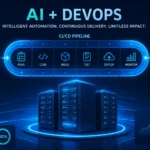
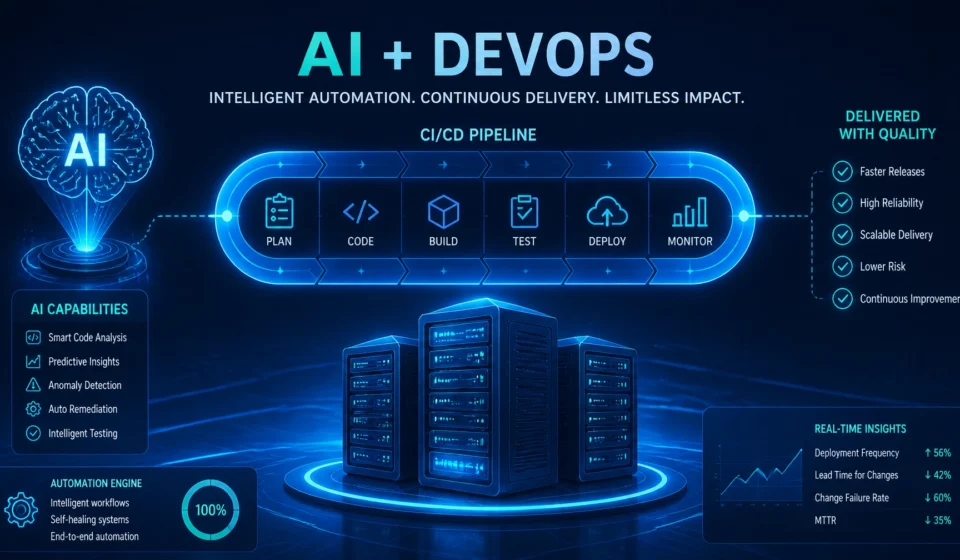
AI-powered CI/CD pipelines introduce cognitive intelligence across every stage of the software delivery lifecycle:
1. Continuous Integration (CI)
During integration, AI analyzes historical build logs and code commits to predict failure probability before a build even runs. Instead of running every single test suite on every minor commit: which wastes compute resources and developer time: AI-driven test selection prioritizes the test cases most relevant to the specific lines of code changed.
2. Continuous Delivery (CD)
When moving code toward production, AI evaluates deployment risk by analyzing historical release patterns, environment telemetry, and complexity metrics. If a deployment carries a high statistical risk of failure during peak traffic hours, the system can recommend shifting the release window or automatically opting for a safer canary rollout strategy.
Predictive Failure Analysis: From Firefighting to Prevention
One of the most powerful applications of AI in DevOps is predictive failure analysis. In legacy environments, teams operate reactively: an alert goes off, engineers scramble to check dashboards, and root-cause analysis begins only after users are already impacted.

AI changes this dynamic by acting as an early warning system for your entire technical infrastructure:
- Anomaly Detection in Logs & Metrics: Machine learning models continuously ingest vast streams of application logs, network telemetry, and infrastructure metrics. They learn what "normal" looks like and immediately flag subtle anomalies that human operators might overlook.
- Forecasting Infrastructure Bottlenecks: By correlating historical incident data with current traffic trends, AI can predict where the next performance bottleneck or hardware degradation is likely to occur.
- Accelerated Root-Cause Analysis (RCA): When incidents do happen, AI tools can instantly scan millions of log lines, cluster recurring errors, and pinpoint the exact commit or configuration change responsible, drastically reducing Mean Time to Repair (MTTR).
Balancing AI Automation with Human Oversight
While autonomous pipelines and self-healing systems sound incredible, successful implementation requires careful governance. AI models are not infallible; they can produce false positives, misinterpret ambiguous logs, or hallucinate solutions if trained on flawed data.
For CIOs, CTOs, and engineering leaders, the goal is not to remove humans entirely, but to create a symbiotic relationship:
- Keep Humans in the Loop for High-Impact Changes: Let AI handle low-risk deployments, automated rollbacks, and routine log analysis. However, mandate human approval for critical production releases, database schema migrations, and security policy updates.
- Treat AI Outputs as Recommendations: Use AI insights: such as "high deployment risk detected" or "flaky test identified": as decision-support mechanisms rather than blunt, un-editable mandates.
- Continuously Train and Refine Models: Ensure your AI tooling is fed clean, domain-specific telemetry so that it learns from your organization's unique infrastructure patterns and past mistakes.
Implementing an AI-Driven DevOps Strategy
Transitioning toward an intelligent DevOps model doesn't happen overnight. Organizations looking to adopt these capabilities should take a phased approach:
- Audit Your Observability Stack: AI is only as good as its data. Ensure your logging, monitoring, and tracing pipelines are robust and centralized.
- Start with High-ROI, Low-Risk Use Cases: Begin with anomaly detection in builds or predictive test selection before moving toward autonomous remediation and self-healing infrastructure.
- Partner with Experts: Navigating tool selection, model integration, and workflow redesign can be complex. Leveraging specialized AI consulting services helps organizations bypass common pitfalls and accelerate time-to-value.
Conclusion
The partnership between Artificial Intelligence and DevOps represents the next great leap in software engineering. By embracing AI-powered CI/CD pipelines and predictive failure analysis, organizations can achieve unprecedented reliability, speed, and operational efficiency.
Ready to modernize your engineering workflows and build a future-proof DevOps strategy? Get expert guidance tailored to your enterprise architecture and technology roadmap.

