



































No More Analog Cooling Monitoring: Why AKCP Intelligent Sensors Are the Only Choice for Modern Data Centers

For decades, running a data center meant relying on rudimentary, analog-style thermostats stuck randomly on a wall or a single digital readout per cooling unit. If you are a CIO, CTO, or Data Center Manager operating under legacy monitoring assumptions today, you are likely burning thousands of dollars in unnecessary electricity while leaving your mission-critical infrastructure exposed to sudden thermal failures.
In modern enterprise environments, simple room-level monitoring is no longer enough. High-density server racks, cloud workloads, and escalating energy costs demand high-precision intelligence. That is why organizations worldwide are ripping out outdated analog methods and upgrading to AKCP intelligent sensor solutions.
In this comprehensive guide, we will explore why AKCP sensor-based monitoring has become the gold standard for enterprise data centers, how it slashes energy bills, protects hardware life, and why lacking this visibility is a massive operational risk.
The Limitations of Analog and Legacy Cooling Monitoring
To understand the shift toward AKCP, we first need to look at what's wrong with traditional analog or basic digital setups:
- The Blind Spots: A single temperature sensor mounted on a wall unit or at the return air vent tells you the ambient temperature of the room: not what is happening inside the high-density server racks.
- Blanket Overcooling: Because teams lack granular data, they overcompensate by turning CRAC/CRAH (Computer Room Air Conditioner / Air Handler) units down to freezing temperatures. This guarantees safety at the expense of massive energy waste.
- No Delta T ($\Delta$T) Visibility: Without tracking the temperature difference between the front air intake and rear exhaust of a rack, you cannot tell if airflow is bypassing your servers or if hot exhaust air is recirculating back into the intakes.
- Reactive Firefighting: Analog gauges and basic alarms only trigger after a threshold is severely breached, often leaving your team scrambling to avert thermal shutdowns.

How AKCP Intelligent Sensors Transform Data Center Cooling
AKCP provides an advanced ecosystem of networked wired and wireless sensors paired with powerful DCIM (Data Center Infrastructure Management) platforms like AKCPro Server and Quicklime DCIM. Here is how AKCP changes the game:
1. Cabinet Thermal Map Sensors (Temperature Chains)
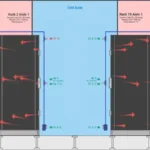
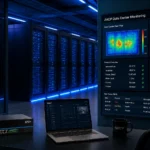
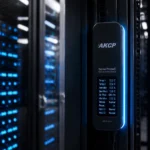
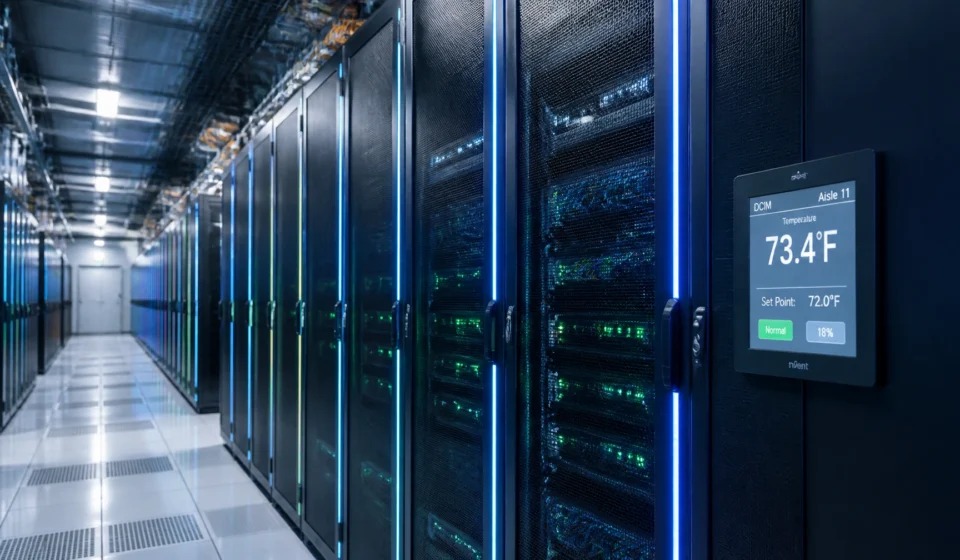
The AKCP Thermal Map Sensor is a masterclass in precision engineering. It consists of a chain of three temperature sensors (plus optional humidity) placed at the top, middle, and bottom of an IT rack. By deploying two strings per rack: one at the front (air intake) and one at the rear (exhaust): you get a complete 3D thermal profile of every single cabinet.
- Automated $\Delta$T Calculation: The system constantly measures the temperature differential between the front and rear, instantly highlighting blocked airflow paths, failing fans, or inefficient cooling distribution.
- ASHRAE Compliance: Ensure your racks adhere strictly to international thermal guidelines without wasting a single kilowatt of cooling power.
2. Digital Twins, sensorCFD, and AI Analytics
AKCP bridges the gap between raw physical data and actionable insights by creating a real-time digital twin of your data center.
Through sensorCFD and embedded AI analytics, live sensor feeds are combined with Computational Fluid Dynamics to model actual airflow patterns, identify air mixing, and pinpoint overcooled zones. According to industry benchmarks and AKCP deployments, these intelligent adjustments can drive up to 10% to 30% reduction in cooling-related energy costs by safely raising AC setpoints and eliminating blanket overcooling.
Saving Electricity and Extending Infrastructure Life
Electricity is one of the highest operational expenditures for any data center. Cooling infrastructure often accounts for up to 40% of total facility energy consumption.
Sashing Your PUE (Power Usage Effectiveness)
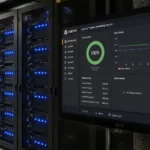
By deploying AKCP power meters and environmental sensors together, your team can track PUE in real time. When you know precisely which racks are running cool and which are running warm, you can optimize fan speeds, adjust chiller setpoints, and stop chilling empty space.
Extending Hardware Lifespan
Thermal stress is the silent killer of enterprise servers, switches, and storage arrays. Constant temperature fluctuations and localized hot spots warp circuit boards, degrade capacitors, and cause premature hard drive failures. AKCP intelligent sensors maintain stable thermal conditions, drastically reducing hardware failure rates and extending the lifecycle of multimillion-dollar IT investments.

The Hidden Risks of NOT Having AKCP in Your Infrastructure
What happens if you continue operating without intelligent, rack-level monitoring like AKCP? The risks go far beyond a warm server room:
- Unplanned Outages & Revenue Loss: A single localized hot spot can trigger thermal shutdowns in core switches or database servers, taking down critical business applications in seconds.
- Wasted CapEx & OpEx: Without accurate sensor data, you might buy additional AC units when your existing cooling capacity is simply mismanaged and trapped in circulation loops.
- Audit and Compliance Failures: Modern banking, fintech, and enterprise audits (such as RBI, SEBI, PCI-DSS, and central bank regulations) increasingly scrutinize environmental controls, redundancy, and uptime resilience in data centers. Lacking robust monitoring puts your compliance standing at risk.
Why AKCP Should Be Your First Purchase Before Any IT Device
Before you invest in your next batch of high-density blade servers, storage arrays, or networking switches, ask yourself: Is our infrastructure protected and optimized to house them?
Purchasing AKCP intelligent sensors before adding new IT equipment ensures that your data center has the foundational visibility needed to absorb new workloads safely. It prevents thermal surprises on day one and guarantees that your infrastructure grows efficiently and resiliently.

Conclusion: Make the Leap to Intelligent Monitoring
Analog cooling monitoring belongs in a museum, not in a modern enterprise data center. By upgrading to AKCP intelligent sensors, you gain complete visibility, slash electricity bills, protect mission-critical uptime, and future-proof your facility against rising energy costs and thermal risks.
Ready to transform your data center operations and secure expert guidance on deploying AKCP solutions?
#ServerRoom #datacenter #serverroom #monitoring #uptime #modbus #remotemanagement #datacenterPUE #datacenteroperations #datacenterhealth #ThermalOptimization #uptime @Nicholas Barrowclough
