






































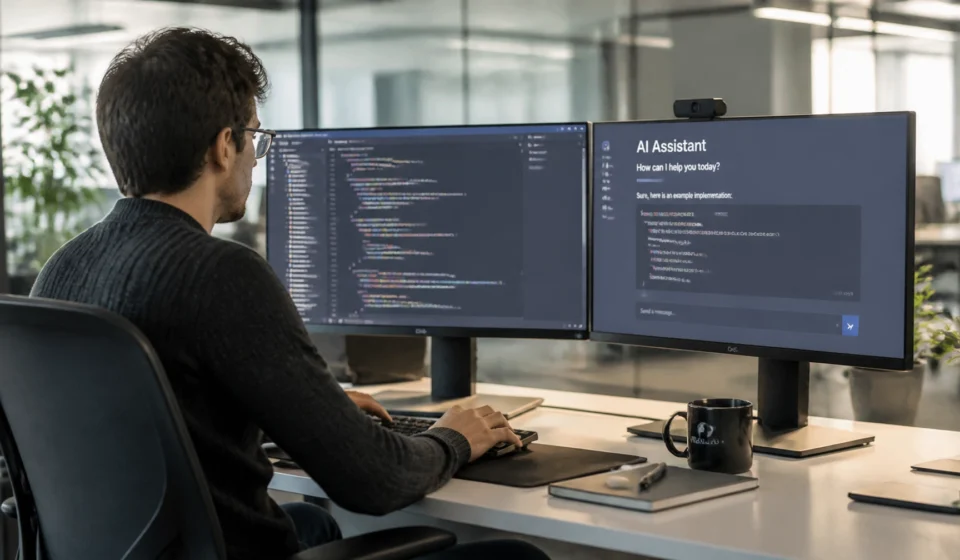

Software engineering has always been about solving complex problems, writing clean logic, and turning abstract business requirements into high-performing digital systems. Yet, for decades, engineers spent a significant portion of their day on repetitive tasks: writing boilerplate code, hunting down syntax errors, setting up repetitive unit tests, and manually digging through legacy documentation.
Today, that paradigm is shifting faster than ever. Artificial Intelligence is no longer just a futuristic concept discussed in research labs; it is an active co-pilot sitting right inside our IDEs. For CIOs, CTOs, and engineering leaders, understanding how to harness these intelligent tools is the key to scaling engineering velocity, reducing time-to-market, and keeping developer burnout at bay.
In this post, we will explore how AI is reshaping software development, how intelligent assistants empower engineers, best practices for integrating AI into your workflows, and how expert AI consulting services can accelerate your digital transformation.
1. The Evolution of Software Engineering in the Age of AI
Remember when setting up a new microservice meant spending hours configuring boilerplate project structures, database connection pools, and logging frameworks? While foundational, these routine tasks consumed valuable cognitive bandwidth that could have been spent solving core product problems.
AI code assistants like GitHub Copilot, Amazon CodeWhisperer, and advanced Large Language Models have changed the game. Instead of starting with a blank file, developers can prompt their environment to generate standard components, data schemas, and API wrappers in seconds.
However, supercharging software engineers isn't about replacing human ingenuity: it's about removing friction. When routine coding becomes instantaneous, engineers can elevate their focus to higher-level concerns: system architecture, security resilience, scalability, and delivering exceptional user experiences.
2. How AI Code Assistants Transform Daily Coding
Modern AI tools act as tireless junior teammates. They understand natural language prompts, analyze existing codebase context, and suggest precise code snippets inline. Here is how they drive daily productivity:
- Instant Boilerplate Generation: Need to spin up a new REST endpoint with standard middleware validation? An AI assistant can draft the entire structure in seconds, adhering to your project's naming conventions.
- Context-Aware Completions: As developers type, AI predicts the next lines of logic based on surrounding functions, imports, and variables, drastically reducing keystrokes and context-switching.
- Accelerated Language Adoption: When teams transition to a new programming language or framework, AI assistants bridge the learning curve by suggesting idiomatic syntax and standard design patterns on the fly.
3. Supercharging Code Review, Bug Detection, and Refactoring
Writing code is only half the battle; maintaining, reviewing, and refactoring it is where engineering teams spend the majority of their lifecycle. AI brings remarkable power to these operational phases.

AI for Code Review and Bug Detection
Code reviews are critical for maintaining code quality, but manual reviews can be time-consuming and prone to overlooking subtle edge cases. AI can pre-screen pull requests, flag security vulnerabilities (such as SQL injection vectors or insecure dependency versions), and highlight missing error-handling logic before a human reviewer even opens the diff.
Behavior-Preserving Refactoring
Refactoring legacy code can be daunting. AI excels at local, behavior-preserving refactors: such as breaking down monolithic functions, cleaning up duplicated code, or modernizing outdated syntax. By feeding architectural constraints into the prompt, engineering teams can clean up technical debt safely and systematically.
4. The Changing Role of Developers in an AI-Augmented World
With powerful AI tools at their disposal, what happens to the role of the software engineer? Are programmers becoming obsolete?
Far from it. The role is evolving from typist of code to architect and reviewer of logic.

In an AI-augmented world, critical thinking is more valuable than ever:
- Prompt Engineering & Context Management: Knowing how to frame problems, provide precise context, and guide AI toward secure, efficient solutions is a core technical skill.
- Rigorous Verification: AI-generated code should always be treated as an untrusted draft. Developers must review every line for correctness, security implications, and adherence to business logic.
- System Design & Integration: While AI can write a function or a class, designing resilient distributed systems, defining data pipelines, and aligning tech stacks with business goals remain deeply human responsibilities.
5. Best Practices for Integrating AI into Development Workflows
Simply handing AI tools to your engineering team without a strategy can lead to messy codebases and security blind spots. To maximize ROI and maintain high engineering standards, consider these best practices:
- Treat AI Output as a Draft: Never merge AI-generated code without thorough human review and automated testing.
- Make Automated Tests Non-Negotiable: Use robust unit tests, integration tests, and CI/CD pipelines as your primary safety net for AI-assisted changes.
- Scope AI Prompts Narrowly: Ask AI to tackle small, well-defined functions or refactors rather than asking it to rewrite an entire microservice in one go.
- Establish Clear Governance: Define organizational guidelines regarding data privacy, intellectual property protection, and what types of code can be shared with external AI models.
6. Leveraging AI Consulting Services for Enterprise Success
Integrating artificial intelligence across an enterprise software organization requires more than just buying software licenses. It demands cultural alignment, workflow redesign, robust security guardrails, and continuous upskilling.
This is where specialized AI consulting services make all the difference. Whether you are looking to deploy private LLMs, integrate AI-driven developer tooling across your engineering organization, or build custom automated workflows, expert guidance ensures you avoid common pitfalls and achieve measurable ROI.
If you are a CIO, CTO, or IT Head planning your next phase of technology modernization, expert guidance can help you navigate tool selection, security compliance, and team training seamlessly.
Conclusion
AI is supercharging software engineers by liberating them from repetitive tasks, accelerating code reviews, and streamlining refactoring. By combining human creativity and architectural vision with the speed of intelligent automation, engineering teams can build better products faster than ever before.
Ready to explore how AI can transform your organization's development workflow or need tailored advice on technology strategy?

