










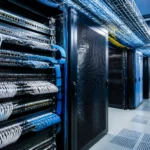


























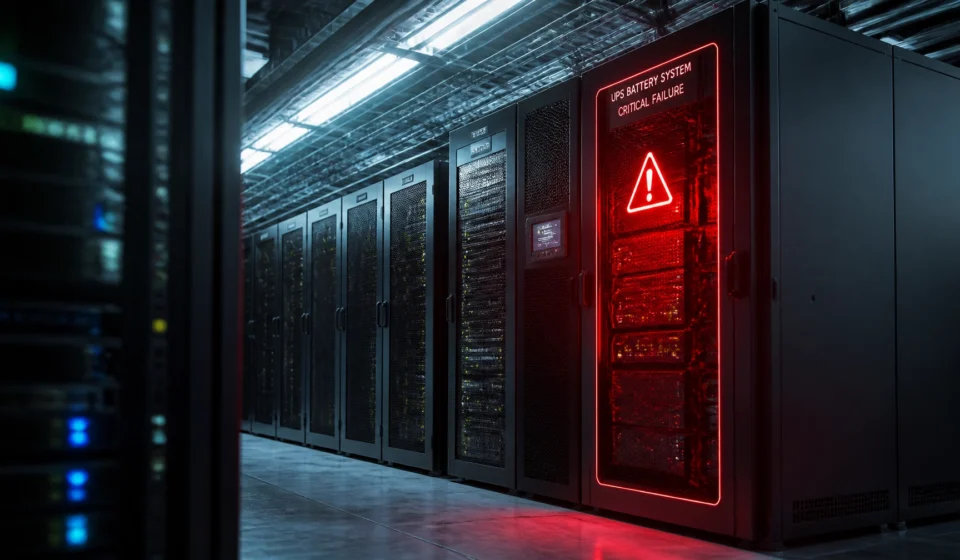

Walk into almost any data center today, and you’ll see it: a row of UPS (Uninterruptible Power Supply) cabinets with reassuring green lights glowing on the front panels. For most CIOs and IT Managers, that green light is a signal that all is well. It’s the digital equivalent of a "thumbs up" from your infrastructure.
But here is the terrifying reality: That green light might be lying to you.
In the world of critical infrastructure, UPS batteries are known as the "silent killers." They sit there, seemingly healthy, until the exact millisecond the mains power fails. That is when the lie is exposed. Instead of taking the load, the battery string collapses, the servers go dark, and the $1 million-per-hour clock of downtime starts ticking.
If you aren't monitoring your batteries at a granular level, you aren't running a data center: you’re running a high-stakes gamble.
The Anatomy of a Lie: Why Lead-Acid Batteries Fail
The vast majority of data centers still rely on Valve Regulated Lead Acid (VRLA) batteries. They are the industry standard because they are cost-effective and familiar. However, they are also temperamental.
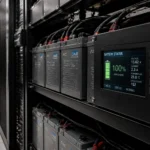
A battery is a chemical engine, and like any engine, it degrades. The problem is that a UPS system often only monitors the string voltage, not the individual health of every cell. One single "weak link" in a string of 40 batteries can cause the entire system to fail under load.
Common causes of this silent degradation include:
- Grid Corrosion: The internal lead plates thin out over time.
- Sulfation: If a battery isn't kept at the perfect charge, lead sulfate crystals build up, permanently reducing its capacity.
- Thermal Runaway: If one cell gets too hot, it can draw more current, getting even hotter, and eventually melting or even exploding, taking the whole rack with it.
- Dry-out: High ambient temperatures (even just 5-10 degrees above the recommended 25°C) can cause the electrolyte to evaporate, killing the battery years before its rated life.
Without continuous monitoring, you have no way of knowing these chemical processes are happening until it's too late.

The $100,000 to $1 Million Mistake
According to the Uptime Institute’s 2024 Outage Analysis, on-site power problems remain the #1 cause of serious data center outages, accounting for roughly 44% of all major failures. Within that category, UPS battery failure is the leading cause.
Let’s talk numbers, because that’s what keeps CEOs and CFOs awake at night. Recent industry data shows that:
- 54% of significant outages cost more than $100,000.
- 16–20% of outages now exceed $1 million.
- In sectors like financial services or global e-commerce, the cost of downtime can easily reach $9,000 per minute.
If you are a CIO in India dealing with RBI or SEBI audits, or a CTO in the UAE managing Central Bank compliance, an outage isn't just a technical failure: it’s a regulatory disaster. The "risk" isn't just losing data; it's losing your license to operate.
Why Manual Audits Aren't Enough
Many organizations rely on a "quarterly check-up" from a service provider. A technician comes in, takes a few manual readings, and signs off. This is better than nothing, but it’s still dangerous.
A battery can go from "healthy" to "critical" in a matter of weeks, especially if there has been a minor spike in room temperature or a brief discharge event. Manual audits are a snapshot in time; real-time monitoring is a movie. You need the movie to see the plot twists coming.
This is why we advocate for AKCP Battery Monitoring Solutions. You need a system that doesn't just watch; it predicts.

The AKCP Solution: Turning Data into Defense
At IT Consultant, we guide CIOs on why AKCP should be at the heart of their infrastructure before they even purchase their first server. Why? Because AKCP doesn't just give you a "red or green" light. It gives you the "why."
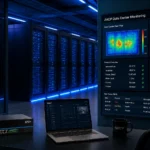
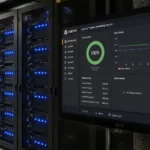
The AKCP Battery Monitoring System (BCMS) provides a "single pane of glass" view into your power health. Here’s how it saves your business:
- Individual Cell Monitoring: It tracks the voltage and internal resistance of every single battery in the string. If one cell starts to drift, you get an alert before it kills the string.
- Temperature Sensing: Since heat is the #1 battery killer, AKCP integrates environmental sensors to ensure your battery room is at the optimal temperature to maximize asset life.
- SNMP Integration: All this data is fed directly into your AKCPro Server or your existing DCIM. You don't have to go to the basement to check the status; it’s on your phone or your NOC dashboard.
- Predictive Analytics: By tracking trends in internal resistance, the system can tell you exactly when a battery needs replacing: long before it actually fails. This moves you from "reactive fire-fighting" to "proactive maintenance."
Compliance: RBI, SEBI, and the Audit Trail
For our clients in the banking, insurance, and financial sectors, the stakes are even higher. Whether you are facing an RBI Audit, a UAE Central Bank Audit, or a SEBI Audit, you are required to prove that you have robust business continuity plans (BCP) in place.
An auditor doesn't want to hear that you "think" your batteries are okay. They want to see the logs. They want to see the discharge curves. They want to see the evidence that you are monitoring your critical power path 24/7.
Having an AKCP solution installed is a powerful "Green Flag" for auditors. It shows that you have eliminated the "Silent Killer" and taken control of your risk management. It transforms your data center from a point of vulnerability into a pillar of reliability.

Don't Wait for the Darkness
If you are a CIO, CTO, or Business Owner, ask yourself one question: When was the last time we actually tested our batteries under a real load?
If the answer makes you nervous, it’s time to act. Don't let your UPS batteries lie to you. Implementing an AKCP Battery Monitoring system is one of the highest-ROI investments you can make in your IT infrastructure. It saves electricity, it extends the life of your expensive battery assets, and most importantly, it saves your business from a million-dollar catastrophe.
How We Can Help
At IT Consultant, we specialize in protecting the infrastructure that powers your business. From Network Audits and Cyber Security Audits to implementing AKCP Solar and Battery Monitoring solutions, we provide the technical knowledge that keeps you ahead of the curve.
Whether you are looking for guidance on the latest AI trends, planning your career growth in the Gulf countries, or need a complete Data Center Audit, our team: led by Shelesh Chauhan: is here to ensure your technology is an asset, not a liability.
Is your data center truly safe? Let's find out together.